


Herb · Lamiaceae family · with preparation per the EMA
rosemary
Salvia rosmarinus
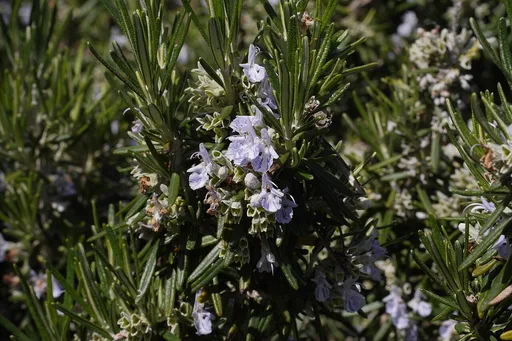
In short a 10-second read
Rosemary (herb) grows to 0.5–1.5 m tall and 0.4–1.2 m wide when mature. It grows best in full sun, in dry to average soil. It flowers in April–June; the flowers are blue. Plant out in March–May, September–November. Hardy to −12 °C.
× spread 0.4–1.2 m
Where to plant
Sun, soil, frost.
It grows best in full sun, in dry to average soil. Hardy to −12 °C.
Sun
Elsewhere it will grow less well.
Soil and water
dry to average · watering: little
Soil: sandy, loamy, gravelly
Frost
It does not take frost well — in winter it needs protection or a pot you can bring indoors.
How much space it takes
Mature size.
The mature plant next to a person (175 cm).
Next to a person
Reaches maturity in about 5–10 years. The final size depends on the cultivar and the spot — we give the range from smallest to largest.
Calendar
What to do and when.
Months for Central Europe. The line shows the current month.
The year at a glance
Flowers
April–June · blue
Pruning
prune after flowering (June–July)
Planting out
container plant: March–May, September–November
Winter protection
shelter from wind
Overwintering
In winter it needs protection.
Before the first frosts: shelter from wind.
- Shelter from wind
- Hardy to −12 °C
- Evergreen — green in winter too
Frequently asked
Quick answers.
When does rosemary flower?
In April–June; the flowers are blue.
Does rosemary tolerate shade?
No, it needs full sun.
How much space does rosemary need?
At maturity 0.4–1.2 m wide and 0.5–1.5 m tall; recommended spacing 50 cm.
Does rosemary survive winter outdoors?
Yes, with protection: shelter from wind.
Where the data comes from
We compared the data in 7 expert sources. Last checked 20 October 2026.
Similar plants
Have a look at these too.

Preparation and use · rosemary
How to prepare it.
According to the monograph of the European Medicines Agency (EMA).
part: leaf
For: mild spasmodic digestive complaints including bloating EMA 4.1For whom: From 12 years · adolescents, adults, elderly EMA 4.2
- What you use
- Dried herb EMA 2
- How it is used
- By mouth EMA 4.2
- Single dose
- 1–2 g of dried leaves in 150–250 ml of boiling water EMA 4.2
- How often
- 2–3× a day EMA 4.2
- Daily total
- 2–6 g a day EMA 4.2
- How long
- If symptoms last longer than 2 weeks or get worse, see a doctor. EMA 4.2
Method
- 1
Put 1–2 g of dried leaves in a cup.
EMA 4.2 - 2
Pour over 150–250 ml of boiling water.
EMA 4.2 - 3
Steep for 5–15 min.
EMA/HMPC/5829/201010:00 - 4
Drink 2–3× a day.
EMA 4.2
part: leaf
Bath at home
For: minor muscle and joint pain, minor peripheral circulation problems EMA 4.1For whom: From 12 years · adolescents, adults, elderly EMA 4.2
- What you use
- Dried herb EMA 2
- How it is used
- In a bath EMA 4.2
- Single dose
- 50 g of dried leaves in 1 l of boiling water EMA 4.2
- How often
- 2–3× a week, daily if needed EMA 4.2
- Preparation
- As a decoction or added directly to the bath EMA 4.2
- Water temperature
- 35–38 °C EMA 4.2
- Bath time
- 10–20 min EMA 4.2
- How long
- If symptoms last longer than 4 weeks or get worse, see a doctor. EMA 4.2
Method
- 1
Weigh out 50 g of dried leaves.
EMA 4.2 - 2
Make a decoction in 1 l of boiling water or add the herb directly to the bath.
EMA 4.2 - 3
The bath water should be 35–38 °C.
EMA 4.2 - 4
Take a bath 2–3× a week, daily if needed.
EMA 4.2 - 5
Stay in the bath for 10–20 min.
EMA 4.2
Dosage
| Form | Single dose | How often | For whom | How long | Instructions |
|---|---|---|---|---|---|
| Herbal tea (infusion)at homepart: leaffor: mild spasmodic digestive complaints including bloating | 1–2 g of dried leaves in 150–250 ml of boiling water EMA 4.2 | 2–3× a day · 2–6 g a day in total EMA 4.2 | From 12 years · adolescents, adults, elderly | longer than 2 weeks → see a doctor EMA 4.2 | |
| Bathat homepart: leaffor: minor muscle and joint pain, minor peripheral circulation problems | 50 g of dried leaves in 1 l of boiling water EMA 4.2 | 2–3× a week | From 12 years · adolescents, adults, elderly | longer than 4 weeks → see a doctor EMA 4.2 | Preparation: as a decoction or added directly to the bath · Water temperature: 35–38 °C · Bath time: 10–20 min EMA 4.2 |
| Children under 12: not recommended EMA 4.2 | |||||
How long
If symptoms last longer than 2 weeks or get worse, see a doctor. — for: mild spasmodic digestive complaints including bloating EMA 4.2
If symptoms last longer than 4 weeks or get worse, see a doctor. — for: minor muscle and joint pain, minor peripheral circulation problems EMA 4.2
Who should not use it
- Children under 12: not recommended EMA 4.2
- If hypersensitive (allergic) to this plant EMA 4.3
- During pregnancy and breastfeeding (not recommended) EMA 4.6
- On broken or irritated skin EMA 4.3
Cautions
- Bile duct obstruction, cholangitis, liver disease, gallstones and other biliary disorders need medical supervision. EMA 4.4
- If symptoms get worse, see a doctor. EMA 4.4
- Joint pain with swelling, redness or fever should be examined by a doctor. EMA 4.4
- With skin inflammation, ulcers, sudden swelling of the legs, heart or kidney failure, or sudden leg pain at rest, see a doctor. EMA 4.4
- With high blood pressure, use a full hot bath with caution. EMA 4.4