


Vegetable · Cucurbitaceae family · with preparation per the EMAornamental and medicinal · also in Medicinal herbs
zucchini, pumpkin
Cucurbita pepo
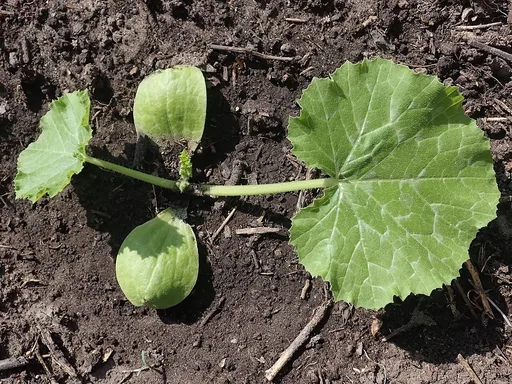
In short a 10-second read
Zucchini, pumpkin (vegetable) grows to 0.3–0.6 m tall and 1–2 m wide when mature. It grows best in full sun, in average to moist soil. Sow in April–June. Harvest in July–October.
× spread 1–2 m
Where to plant
Sun and soil.
It grows best in full sun, in average to moist soil.
Sun
Elsewhere it will grow less well.
Soil and water
average to moist · watering: a lot
Soil: humus-rich, loamy
How much space it takes
Mature size.
The mature plant next to a person (175 cm).
Next to a person
The final size depends on the cultivar and the spot — we give the range from smallest to largest.
Calendar
What to do and when.
Months for Central Europe. The line shows the current month.
The year at a glance
Pruning
No pruning needed — just remove dead or damaged parts.
Sowing
sow indoors: April–May; direct sowing: May–June
Harvest
July–October
Winter protection
does not overwinter
Frequently asked
Quick answers.
When do I sow zucchini, pumpkin?
In April–June (sow indoors, direct sowing).
When is zucchini, pumpkin harvested?
In July–October.
Does zucchini, pumpkin tolerate shade?
No, it needs full sun.
How much space does zucchini, pumpkin need?
At maturity 1–2 m wide and 0.3–0.6 m tall; recommended spacing 100 cm.
Where the data comes from
The data is indicative — we are still comparing it with further sources. Last checked 20 October 2026.
Show sources (7)
- NC State Extension Gardener Plant Toolbox
- RHS — How to grow courgettes
- National Capital Poison Center — Toxic squash syndrome
- NC State Cucurbit Breeding — Bitterness in zucchini squash and cucumber
- EMA/HMPC - Cucurbitae semen (herbal medicine)
- EMA/HMPC - monografia Cucurbitae semen (EMA/HMPC/136024/2010)
- UMD Extension - Growing Summer Squash


Preparation and use · zucchini, pumpkin
How to prepare it.
According to the monograph of the European Medicines Agency (EMA).
part: seed
Seeds
For: lower urinary tract symptoms with benign prostate enlargement or overactive bladder once a doctor has excluded serious conditions EMA 4.1For whom: From 18 years · adults, elderly EMA 4.2
- What you use
- Dried herb EMA 4.2 EMA 2
- How it is used
- By mouth EMA 4.2
- Single dose
- 2.5–7.5 g of dried seeds EMA 4.2
- How often
- 2× a day EMA 4.2
- Long-term use
- Can be used long-term EMA 4.2
Method
- 1
Weigh out 2.5–7.5 g of dried seeds.
EMA 4.2 - 2
Take it 2× a day.
EMA 4.2
For: lower urinary tract symptoms with benign prostate enlargement or overactive bladder once a doctor has excluded serious conditions EMA 4.1For whom: From 18 years · adults, elderly EMA 4.2
- What you use
- Comminuted herb EMA 4.2
- How it is used
- By mouth EMA 4.2
- Single dose
- 2.5–7.5 g of dried seeds EMA 4.2
- How often
- 2× a day EMA 4.2
- Long-term use
- Can be used long-term EMA 4.2
Method
- 1
Weigh out 2.5–7.5 g of dried seeds, crushed. EMA 4.2
- 2
Take it 2× a day. EMA 4.2
Dosage
| Form | Single dose | How often | For whom | How long | Instructions |
|---|---|---|---|---|---|
| Seedspart: seed | 2.5–7.5 g of dried seeds EMA 4.2 | 2× a day | From 18 years · adults, elderly | Long-term use: can be used long-term EMA 4.2 | |
| Adults only EMA 4.2 | |||||
Who should not use it
- Adults only EMA 4.2
- If hypersensitive (allergic) to this plant EMA 4.3
- During pregnancy EMA 4.4
Cautions
- Only after a doctor has excluded serious conditions. EMA 4.1
- If fever, painful urination, spasms or blood in the urine occur, see a doctor. EMA 4.4
- If symptoms get worse, see a doctor. EMA 4.4