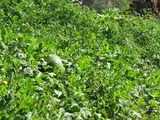
Vegetable · Cucurbitaceae family

Watermelon

Citrullus lanatus

Full sun 0.1–0.2 m × 1.5–3 m Sow April–June Moderate care

In short a 10-second read

SunFull sun
Size0.1–0.2 m
spacing 90 cm
PlantingMay–June
Care levelModerate care

Where to plant and how much to water

Sun, soil and water.

It grows best in full sun, in average to moist soil.

Sun

Sun6 hours or more
Part shade3–6 hours
Shadeunder 3 h

Soil

acidic to neutral soil
acidicneutralalkaline
average to moistloamy

Watering

keep the soil evenly moistat the base, not on the leavesdo not waterlogless when it rains

How much space it takes

Mature size.

The mature plant next to a person (175 cm).

50 cm1 m1.5 m0.1–0.2 mspread 1.5–3 m
0.1–0.2 m× spread 1.5–3 m

Plant 90 cm apart.

How to plant: singly, 90 cm apart

The final size depends on the cultivar and the spot — we give the range from smallest to largest.

Calendar

Through the year.

Months for Central Europe. The line shows the current month.

The year at a glance

Sowing: JanuarySowing: FebruarySowing: MarchSowing: AprilSowing: MaySowing: JuneSowing: JulySowing: AugustSowing: SeptemberSowing: OctoberSowing: NovemberSowing: DecemberPlanting: JanuaryPlanting: FebruaryPlanting: MarchPlanting: AprilPlanting: MayPlanting: JunePlanting: JulyPlanting: AugustPlanting: SeptemberPlanting: OctoberPlanting: NovemberPlanting: DecemberProtection: JanuaryProtection: FebruaryProtection: MarchProtection: AprilProtection: MayProtection: JuneProtection: JulyProtection: AugustProtection: SeptemberProtection: OctoberProtection: NovemberProtection: DecemberJanFebMarAprMayJunJulAugSepOctNovDec
SowingPlantingProtection
Now, in October: nothing to do — the next job is in April.
JanFebMarAprMayJunJulAugSepOctNovDec

Sowing

JanFebMarAprMayJunJulAugSepOctNovDec

sow indoors: April; direct sowing: May–June

Planting

JanFebMarAprMayJunJulAugSepOctNovDec

transplant outdoors: May–June

Protection

JanFebMarAprMayJunJulAugSepOctNovDec

May (protection): Cover young plants with a row cover against insects right after planting and remove it at first bloom.

Feeding

Nutrition.

Moderate
balanced fertiliser

Most often lacking: calcium → brown patch at the blossom end of the fruit

Pests and diseases

Common problems and what to do.

The most common problems in Central Europe. Protection is listed from the gentlest option.

High riskMedium riskLow riskRisk for this plant according to the source · no label = no documented level

What you will see

Discoloured areas on the top of leaves, with a white, grey or purple coating beneath.

The source says: it can be a serious disease of the gourd family.

When to look

Mainly summer and autumn, especially in damp conditions

How to protect

  1. Prevention
    • Do not plant densely; weed so air can circulate.
    • Water in the morning and avoid wetting the leaves in the evening.
    • Rotate crops; soil spores survive.
  2. By hand as soon as it appearsPull off affected leaves and dispose of them (burying, burning, recycling centre).
Downy mildewsdisease · mainly summer and autumn, especially in damp conditionsHigh risk

What you will see

Discoloured areas on the top of leaves, with a white, grey or purple coating beneath.

The source says: it can be a serious disease of the gourd family.

When to look

Mainly summer and autumn, especially in damp conditions

How to protect

  1. Prevention
    • Do not plant densely; weed so air can circulate.
    • Water in the morning and avoid wetting the leaves in the evening.
    • Rotate crops; soil spores survive.
  2. By hand as soon as it appearsPull off affected leaves and dispose of them (burying, burning, recycling centre).
More about this problem

Gummy stem blight

Didymella bryoniae
High riskdisease

What you will see

Brown or white lesions on stems and crowns that sometimes ooze an amber sticky liquid; it spreads faster in warm, humid weather.

The source says: it is a major disease of watermelon.

When to look

Warm and humid

How to protect

  1. Prevention
    • Buy seed from a reputable supplier and transplants without necrotic leaf margins or ooze on the stem.
    • Keep debris of other cucurbits away from watermelons and grow cucurbits in the same spot again only after 3–4 years.
    • Do not wound the fruit at harvest and store it at 7–10 °C to prevent post-harvest black rot.
  2. By hand at the end of the seasonAt the end of the season remove and destroy dead plant debris.
Gummy stem blightdisease · warm and humidHigh risk

What you will see

Brown or white lesions on stems and crowns that sometimes ooze an amber sticky liquid; it spreads faster in warm, humid weather.

The source says: it is a major disease of watermelon.

When to look

Warm and humid

How to protect

  1. Prevention
    • Buy seed from a reputable supplier and transplants without necrotic leaf margins or ooze on the stem.
    • Keep debris of other cucurbits away from watermelons and grow cucurbits in the same spot again only after 3–4 years.
    • Do not wound the fruit at harvest and store it at 7–10 °C to prevent post-harvest black rot.
  2. By hand at the end of the seasonAt the end of the season remove and destroy dead plant debris.

What you will see

Wilting of one or more vines, leaves turn yellow and the vascular tissue in the stem is discoloured.

The source says: it is a devastating disease that can cut watermelon yields significantly.

How to protect

  1. Prevention
    • Grow cucurbits in the same spot only after 3–4 years.
  2. By hand as soon as it is foundRemove and destroy affected plants away from compost; sprays work poorly on diseases inside the stem.
Fusarium wiltdiseaseHigh risk

What you will see

Wilting of one or more vines, leaves turn yellow and the vascular tissue in the stem is discoloured.

The source says: it is a devastating disease that can cut watermelon yields significantly.

How to protect

  1. Prevention
    • Grow cucurbits in the same spot only after 3–4 years.
  2. By hand as soon as it is foundRemove and destroy affected plants away from compost; sprays work poorly on diseases inside the stem.
More about this problem

What you will see

White powdery coating on leaves, stems and flowers.

When to look

From spring, especially later in the season

How to protect

  1. Prevention
    • Water regularly and do not let plants suffer from drought; mulch (leave the area by the stem clear).
    • Improve airflow around plants.
    • Grow varieties with partial resistance, if available.
  2. By hand as soon as it appearsRemove affected leaves early; dispose of fallen affected leaves in autumn.
Powdery mildewsdisease · from spring, especially later in the season

What you will see

White powdery coating on leaves, stems and flowers.

When to look

From spring, especially later in the season

How to protect

  1. Prevention
    • Water regularly and do not let plants suffer from drought; mulch (leave the area by the stem clear).
    • Improve airflow around plants.
    • Grow varieties with partial resistance, if available.
  2. By hand as soon as it appearsRemove affected leaves early; dispose of fallen affected leaves in autumn.
More about this problem

What you will see

Colonies of tiny insects on young shoots and under leaves, stunted and distorted growth, sticky honeydew and black sooty mould on it.

When to look

Spring and summer

How to protect

  1. Prevention
    • Tolerate a small number: aphids are food for beneficial insects.
    • Check plants often so you can act in time.
    • Encourage ladybirds, hoverflies, lacewings and parasitic wasps.
  2. By hand as soon as you spot themSquash colonies with your fingers or remove affected shoot tips.
  3. Biological before a heavy infestationIn a greenhouse you can buy in hoverfly larvae, lacewings and parasitic wasps.
  4. Chemical — only when nothing else helps according to the product labelLast resort only: a product authorised in your country against aphids. Try non-chemical methods first.
Aphidspest · spring and summer

What you will see

Colonies of tiny insects on young shoots and under leaves, stunted and distorted growth, sticky honeydew and black sooty mould on it.

When to look

Spring and summer

How to protect

  1. Prevention
    • Tolerate a small number: aphids are food for beneficial insects.
    • Check plants often so you can act in time.
    • Encourage ladybirds, hoverflies, lacewings and parasitic wasps.
  2. By hand as soon as you spot themSquash colonies with your fingers or remove affected shoot tips.
  3. Biological before a heavy infestationIn a greenhouse you can buy in hoverfly larvae, lacewings and parasitic wasps.
  4. Chemical — only when nothing else helps according to the product labelLast resort only: a product authorised in your country against aphids. Try non-chemical methods first.
More about this problem

What you will see

The blossom end of the fruit starts to rot and soon the whole fruit rots. It is not a pest or a disease: the fruit does not get enough calcium when water supply is uneven.

When to look

Summer

How to protect

  1. Prevention
    • Water evenly, once a week in dry weather.
    • Do not over-fertilise with nitrogen: uneven moisture and excess nitrogen block calcium uptake.
  2. By hand as soon as it is foundAn affected fruit cannot be saved; remove it and water evenly so the problem does not repeat.
Blossom end rotphysiological disorder · summer

What you will see

The blossom end of the fruit starts to rot and soon the whole fruit rots. It is not a pest or a disease: the fruit does not get enough calcium when water supply is uneven.

When to look

Summer

How to protect

  1. Prevention
    • Water evenly, once a week in dry weather.
    • Do not over-fertilise with nitrogen: uneven moisture and excess nitrogen block calcium uptake.
  2. By hand as soon as it is foundAn affected fruit cannot be saved; remove it and water evenly so the problem does not repeat.
More about this problem

Cucumber beetles

pest

What you will see

Beetles feed on leaves and young plants and harm seedlings and young plants most.

When to look

Early in the season

How to protect

  1. Prevention
    • Cover plants with a row cover right after planting and remove it at first bloom so bees can pollinate.
  2. By hand from planting to first bloomHand-pick beetles and cover young plants with netting or a row cover.
Cucumber beetlespest · early in the season

What you will see

Beetles feed on leaves and young plants and harm seedlings and young plants most.

When to look

Early in the season

How to protect

  1. Prevention
    • Cover plants with a row cover right after planting and remove it at first bloom so bees can pollinate.
  2. By hand from planting to first bloomHand-pick beetles and cover young plants with netting or a row cover.
Sources (8)

Frequently asked

Quick answers.

When do I sow watermelon?

In April–June (sow indoors, direct sowing).

Does watermelon tolerate shade?

No, it needs full sun.

How much space does watermelon need?

At maturity 1.5–3 m wide and 0.1–0.2 m tall; recommended spacing 90 cm.

Powdery mildews — what can you do?

Water regularly and do not let plants suffer from drought; mulch (leave the area by the stem clear). Remove affected leaves early; dispose of fallen affected leaves in autumn.

Downy mildews — what can you do?

Do not plant densely; weed so air can circulate. Pull off affected leaves and dispose of them (burying, burning, recycling centre).

Sources (6) Checked 23 October 2026

Similar plants

Have a look at these too.

Plan this plant in your garden in Studio