


Perennial · Asteraceae family · with preparation per the EMAornamental and medicinal · also in Medicinal herbs
purple coneflower
Echinacea purpurea
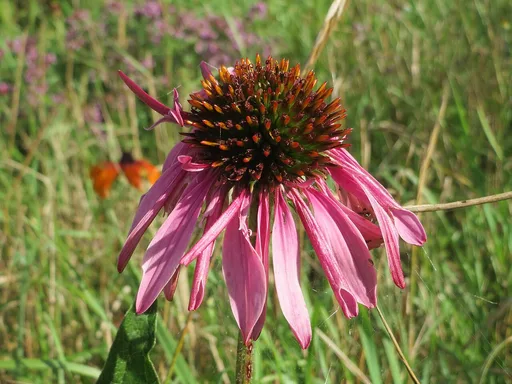
In short a 10-second read
Purple coneflower (perennial) grows to 0.9–1.2 m tall and 0.4–0.6 m wide when mature. It grows best in full sun to part shade, in dry to average soil. It flowers in July–September; the flowers are pink, purple, white, red, orange or green. Hardy to −32 °C.
× spread 0.4–0.6 m
Where to plant
Sun, soil, frost.
It grows best in full sun to part shade, in dry to average soil. Hardy to −32 °C.
Sun
Tolerates several positions — choose to suit the rest of the garden.
Soil and water
dry to average · watering: little
Soil: loamy, humus-rich
Frost
It copes with a normal winter outdoors.
How much space it takes
Mature size.
The mature plant next to a person (175 cm).
Next to a person
Reaches maturity in about 2–5 years. The final size depends on the cultivar and the spot — we give the range from smallest to largest.
Calendar
What to do and when.
Months for Central Europe. The line shows the current month.
The year at a glance
Flowers
July–September · pink, purple, white, red, orange or green
Pruning
deadhead spent flowers (as needed)
Planting
container plant: March–May, September–November
Winter protection
not needed
Overwintering
It copes with winter on its own.
It overwinters outdoors without protection, hardy to −32 °C.
- Needs no protection
- Hardy to −32 °C
- Dies back in winter and regrows in spring
What to combine it with
Same needs, different flowering.
They share the same sun and soil and flower in other months — so the bed flowers for longer.

Chinese peony
0.45–0.75 m
Columbine
0.45–0.9 m
Japanese barberry
0.6–1.5 mReady-made Studio combinations that include purple coneflower


Pink coneflowers and blue salvia among swaying grasses that still…


A blue and pink mix of catmint, salvia and coneflower that feeds bees…


Annual cosmos and zinnias with coneflower and peony — flowers for the…
Frequently asked
Quick answers.
When does purple coneflower flower?
In July–September; the flowers are pink, purple, white, red, orange or green.
Does purple coneflower tolerate shade?
It tolerates part shade (3–6 hours of sun), but not full shade.
How much space does purple coneflower need?
At maturity 0.4–0.6 m wide and 0.9–1.2 m tall; recommended spacing 38 cm.
Does purple coneflower survive winter outdoors?
Yes, without protection, hardy to −32 °C.
Where the data comes from
The data is indicative — we are still comparing it with further sources. Last checked 17 October 2026.
Show sources (18)
- NC State Extension Gardener Plant Toolbox
- RHS Plant Finder
- Chicago Botanic Garden Plant Finder
- Plants For A Future
- EPPO Global Database
- EPPO Reporting Service — update of the EU list of invasive alien species
- Bamberger Staudengarten (Strobler), katalóg
- Foerster-Stauden, katalóg
- EMA/HMPC - Echinaceae purpureae herba (herbal medicine)
- Iowa State Extension - How to Plant Perennials
- RHS - How to grow perennial plants
- Wilson Bros Gardens
- Proven Winners
- Perennials.com
- RHS
- RHS
- RHS
- Sturton Plants
Similar plants
Have a look at these too.

Preparation and use · purple coneflower
How to prepare it.
According to the monograph of the European Medicines Agency (EMA).
part: fresh aerial parts
Expressed juice from a pharmacy
A ready-made product. The exact method is in the package leaflet.
For: short-term prevention and treatment of the common cold EMA 4.1For whom: From 12 years · adolescents, adults, elderly EMA 4.2
- What you use
- Expressed juice EMA 4.2
- How it is used
- By mouth EMA 4.2
- Single dose
- 1.5–4.5 ml EMA 4.2
- Daily total
- 6–9 ml a day EMA 4.2
- When to start
- At the first signs EMA 4.2
- How long
- Use for no more than 10 days. EMA 4.2
Method
- 1
Start at the first signs.
EMA 4.2 - 2
Measure out 1.5–4.5 ml of expressed juice.
EMA 4.2
Dosage
| Form | Single dose | How often | For whom | How long | Instructions |
|---|---|---|---|---|---|
| Expressed juicefrom a pharmacypart: fresh aerial parts | 1.5–4.5 ml EMA 4.2 | 6–9 ml a day in total EMA 4.2 | From 12 years · adolescents, adults, elderly | at most 10 days EMA 4.2 | When to start: at the first signs EMA 4.2 |
| Children under 12: not recommended EMA 4.2 | |||||
How long
Use for no more than 10 days. EMA 4.2
Who should not use it
- Children under 12: not recommended EMA 4.2
- If hypersensitive (allergic) to this plant EMA 4.3
- If allergic to plants of the daisy family (Asteraceae) EMA 4.3
- With progressive systemic or autoimmune disease, immunodeficiency, immunosuppression or white blood cell disorders EMA 4.4
Cautions
- People prone to allergies (atopic) should consult a doctor first — risk of a severe allergic reaction. EMA 4.4
- If high fever occurs, see a doctor. EMA 4.4
- If symptoms get worse, see a doctor. EMA 4.4