Amounts in this text are indicative, not the GridGarden price list. Current prices for the delivery country (Germany) are on the product pages and in Studio.
Raised beds dry out 40-60% faster than in-ground gardens due to elevated sides and improved drainage. In Central European summers (zones 6-7), water 1-2x daily when temperatures exceed 25°C. A 120x60cm bed needs roughly 15-20 liters per watering. Drip irrigation saves up to 70% water and is the best long-term investment for any bed larger than 1m².
Raised beds give you better soil, fewer weeds, and higher yields — but they also dry out faster than in-ground plots. The elevated position, good drainage, and composting layers all accelerate moisture loss, which catches many beginners off guard after their first hot week. This guide answers the most common questions: how often to water, which method is most efficient, and how to automate the whole thing so your plants survive your summer holiday. All data is calibrated for Central European climate zones 6-7 (Slovakia, Czech Republic, Germany, Austria, Poland, Hungary).
Why Do Raised Beds Need More Water Than In-Ground Gardens?
Raised beds lose moisture faster than ground-level plots for four compounding reasons. Understanding them helps you plan the right irrigation strategy before planting.
1. Elevated sides heat up in the sun. Wooden planks, especially south-facing panels, absorb solar radiation and warm the soil from the edges inward. This raises soil temperature by 3-6°C compared to in-ground beds — beneficial for early-season warming but it accelerates evaporation throughout summer.
2. Superior drainage is a double-edged feature. The open bottom and well-aerated soil mix that makes raised beds excel at preventing waterlogging also means water moves through faster. A 40cm deep bed with a classic 40% compost / 40% topsoil / 20% perlite mix can drain completely after a heavy rain within 4-6 hours.
3. Limited soil volume means limited water storage. A 120x60cm bed at 40cm depth holds roughly 290 liters of growing medium. Compare that to in-ground planting where roots can draw from several cubic meters of soil in any direction. Your plants are working from a finite reservoir.
4. Active composting layers generate heat. The lower Hugelkultur-style layers that warm spring beds also continue producing gentle heat through summer, contributing to faster evaporation from the bottom up. This is largely invisible but measurable — beds with active organic layers are typically 2-4°C warmer than beds without.
If you are just setting up your first raised bed, the complete guide to raised garden beds covers everything from sizing to soil filling before you start worrying about irrigation.
How Often Should You Water a Raised Bed?
Watering frequency depends on season, temperature, bed depth, and plant type. The table below gives reliable baseline frequencies for Central European climate zones 6-7. Always verify with the finger test (see next section) rather than following a schedule mechanically.
| Season / Condition | Typical Frequency | Approx. Volume (120x60cm bed) | Notes |
|---|---|---|---|
| Early spring (10-15°C) | Every 3-4 days | 8-12 liters | Seedlings are small, evaporation low |
| Late spring (15-22°C) | Every 2-3 days | 12-18 liters | Plants growing fast, demand increases |
| Summer, moderate (22-28°C) | Daily or every other day | 15-20 liters | Check soil morning and evening |
| Summer heat wave (>30°C) | 1-2x daily | 20-30 liters | Morning + evening; mulch is essential |
| Autumn (10-18°C) | Every 3-5 days | 8-15 liters | Depends on rain; autumn is often wet in CE |
| After rainfall (>10mm) | Skip 1-2 days | — | Always verify with finger test first |
Weekly total in peak summer: A standard 120x60cm bed (0.72m²) needs approximately 75-100 liters per week during July and August in Slovakia or Czech Republic. Scale proportionally for larger beds: a 240x80cm bed (1.92m²) needs 200-260 liters per week.
The Finger Test: The Only Reliable Watering Indicator
The single most reliable way to know when to water is the finger test. Push your index finger 2-3cm into the soil surface. If the soil at that depth feels dry or barely moist, it is time to water. If it feels clearly damp, wait another day.
This 5-second test beats every watering schedule because it accounts for variables no schedule can predict: cloud cover, wind, recent rain, plant root uptake, and soil composition. Make it a morning habit — check before you reach for the hose. You will waste less water and stress plants less by overwatering in cool periods.
For beginner gardeners, the classic mistake is watering on a fixed schedule regardless of conditions. A week of overcast, cool weather in June means you can skip 3-4 consecutive waterings. A week of 32°C heat with wind means watering twice daily is not excessive. The soil knows — just check it.
When Is the Best Time of Day to Water?
Morning watering (before 10:00) is the clear optimal choice. Watering in the evening is acceptable as a backup but carries risks, and midday watering should be avoided entirely.
Morning (06:00-10:00): Soil is at its coolest, evaporation is minimal, and leaves dry quickly as the day warms. Water reaches roots efficiently rather than evaporating from the surface. Fungal disease risk is low because foliage dries within 1-2 hours. This is when most professional growers irrigate.
Evening (18:00-20:00): Soil is still warm, so water is absorbed well. The problem is that leaves that get wet remain wet overnight, creating ideal conditions for fungal diseases like powdery mildew, botrytis, and downy mildew. If you must water in the evening, direct water at the soil base rather than the foliage. Drip irrigation eliminates this problem entirely.
Midday (10:00-16:00): Up to 40% of water is lost to direct evaporation before it penetrates more than a few centimeters. Cold tap water in hot, direct sun can also cause thermal shock to roots. Avoid this window except for emergency wilting situations.
Comparing Watering Methods: Which System Is Right for You?
The best irrigation method depends on your bed size, budget, and how much time you want to spend in the garden. The comparison below covers the full spectrum from the simplest to the most automated options.
| Method | Cost (setup) | Water Efficiency | Setup Difficulty | Time per Day | Best For |
|---|---|---|---|---|---|
| Watering can | €5-15 | 60-70% | None | 10-20 min | 1-2 small beds, balconies |
| Garden hose + nozzle | €20-60 | 55-65% | Minimal | 5-15 min | Multiple beds, easy access |
| Soaker hose | €15-35 | 75-80% | Easy (lay flat) | 2-5 min (manual valve) | Row crops, one bed at a time |
| Drip irrigation system | €40-120 | 85-95% | Moderate (1-2 hours setup) | 0 min (with timer) | Multiple beds, 1m²+ setups |
| Ollas (clay pots) | €8-25 per olla | 90-95% | None (just bury) | 2-5 min (refill 2-3x/week) | Tomatoes, peppers, water-scarce areas |
| Smart system (timer + sensor) | €80-250 | 90-97% | Moderate-High (app setup) | 0 min | 3+ beds, vacation periods, tech users |
For most hobby gardeners with 2-4 raised beds, a drip irrigation system with a basic mechanical timer (€40-80 total) hits the sweet spot of cost, efficiency, and automation. It pays for itself in one summer of water savings and completely eliminates the daily watering burden.
How to Set Up Drip Irrigation for Raised Beds: Step by Step
Drip irrigation delivers water directly to the root zone at a slow, controlled rate, achieving 85-95% water efficiency compared to 55-65% for overhead watering. A standard kit costs €40-90 and takes about 90 minutes to install.
What you need:
- Mechanical or digital timer (€15-40) — connect directly to the tap
- Main supply line (16mm poly tubing)
- T-connectors and end caps
- Drip lines or soaker hose for each bed (4mm or 8mm)
- Pressure regulator if your water pressure exceeds 2.5 bar (optional but recommended)
- Hole punch tool and connection stakes
Installation steps:
- Attach the timer to your outdoor tap. Set it to run 15-25 minutes per cycle, once or twice daily depending on season. Morning is preferred.
- Run the main 16mm line from the tap along the path between your beds. Use stakes to hold it flat on the ground.
- For each bed, punch a hole in the main line and insert a T-connector. Run a secondary 8mm or 4mm line into the bed.
- Lay drip lines across the bed surface, spacing them 25-30cm apart. For a 60cm-wide bed, two parallel lines work well. Use small stakes to keep the lines flat.
- Place drip emitters (0.5-2 liters per hour flow rate) near each plant cluster, or use continuous soaker line for dense plantings like salad or herbs.
- Cap all end points and run a test cycle. Adjust emitter positions where you see dry patches or puddles forming.
- Set the timer and fine-tune over the first week using the finger test to verify soil moisture at depth.
Expected water use: A drip system running 20 minutes at 1 L/hr per emitter (8 emitters in a 120x60cm bed) delivers 2.7 liters per cycle — compared to 15-20 liters from a watering can covering the same area. The drip water goes directly to roots; can watering loses 30-40% to evaporation and surface runoff.
Smart controller instead of a plain timer. A mechanical timer runs its schedule whether it rained overnight or not. A smart controller (€80-250) adds a weather feed, a soil moisture sensor or evapotranspiration data and adjusts the schedule on its own — skipping a cycle after rain, extending it during a heat wave. Against a fixed-schedule timer that saves roughly another 15-30% of water, and it removes the main failure mode of automated watering: soaking a bed that was already wet. For three or more beds, or for long absences, the extra cost typically pays back within two or three seasons.
Ollas: Ancient Technology That Still Works Perfectly
Ollas (pronounced "oy-yahs") are unglazed clay pots buried in the soil with only the neck protruding above the surface. They have been used in irrigation for over 4,000 years, from China to Mexico, and they remain one of the most efficient passive irrigation tools available today.
How they work: The porous clay wall allows water to seep slowly into the surrounding soil through osmosis. As plant roots extract moisture from the soil, the localized pressure drop pulls more water through the clay. The system is entirely self-regulating — in wet conditions, seepage slows; in dry heat, it accelerates. Water loss from evaporation is less than 5%.
Setup: Bury the olla so that 3-5cm of the neck extends above the soil. Fill with water every 2-3 days in summer (daily during heat waves). Companion-plant 2-4 plants within 25-30cm of each olla for maximum benefit.
Cost: Handmade ceramic ollas run €8-25 each. A 120x60cm bed typically needs 2-3 ollas. For a DIY alternative, bury a terracotta pot with the drainage hole plugged, and use a matching saucer as a lid to reduce evaporation from the opening.
Ollas work exceptionally well for tomatoes, peppers, eggplant, and cucumbers — crops that prefer consistent root-zone moisture without wet foliage. They are also an excellent solution for the weeks you spend away from home, as a fully filled olla can maintain soil moisture for 4-7 days depending on temperature.
For companion planting ideas around high-water-demand crops, the article on what to plant in raised beds covers plant groupings and water demand profiles in detail.
Mulching: The Lowest-Effort Upgrade for Moisture Retention
Mulching is the single highest-return-on-effort action you can take to reduce watering frequency. A 5-8cm layer of organic mulch over the soil surface reduces evaporation by 25-50%, which directly translates to watering 30-40% less often during summer.
Best mulch options for raised beds:
- Straw — cheap, widely available, excellent insulation. Works for all vegetables. Apply 7-10cm deep. Replace once per season as it composts down.
- Bark mulch (pine or softwood) — longer-lasting (2-3 seasons), good for berry bushes and perennials. Avoid fine bark dust near seedlings.
- Grass clippings — free if you have a lawn. Apply in thin layers (max 3cm) to prevent matting and anaerobic decomposition. Excellent nitrogen boost as they break down.
- Compost mulch — 3-5cm of finished compost as a surface dressing feeds plants while retaining moisture. Best early-season application.
- Living mulch (low-growing ground covers) — white clover, nasturtium, or thyme between taller plants. Reduces soil exposure, adds biodiversity.
Application tip: Keep mulch 3-5cm away from plant stems to prevent stem rot. Mulch is most effective when applied after watering — it seals in existing moisture rather than blocking access to dry soil.
Beyond moisture retention, mulch suppresses weeds, moderates soil temperature swings, and feeds soil biology as it decomposes. It is arguably the most universally beneficial thing you can do for a raised bed garden with minimal effort.
Which Plants Need the Least Water in a Raised Bed?
Plant choice is the cheapest irrigation upgrade there is — it costs nothing and it works before you buy a single metre of tubing. Three visual cues signal drought tolerance: silvery or grey foliage, small or needle-like leaves, and deep taproots. Mediterranean herbs tick all three, and once established most of them need no supplemental watering at all in a Central European summer.
Low water demand — every 3-5 days, even in July: rosemary, thyme, sage, lavender, oregano, chard, beans, onions, garlic, carrots, beetroot and radish. Over-watering herbs in this group actively weakens their aroma, so restraint is the correct strategy rather than a compromise.
High water demand — daily in summer: tomatoes, cucumbers, zucchini, pumpkin, celery, lettuce and most leafy greens. These are the crops worth pairing with ollas or a dedicated drip line.
The practical conclusion is to group plants by water demand rather than by plant family: keep the thirsty crops together in one bed with drip irrigation or ollas, and put the herbs and root vegetables in a separate bed you visit twice a week. With a modular bed system this is a layout decision made before you build, not a compromise afterwards — one bed can run on a timer while its neighbour is left alone.
How to Improve Soil So It Holds More Water
Irrigation decides how efficiently water is delivered; the soil decides how much of it stays available to the roots afterwards. A sandy, low-organic mix can lose usable moisture within hours, while a well-built raised bed mix keeps a reserve for days. Four things make the difference.
- Organic matter is the main lever. Mature compost and well-rotted manure behave like a sponge — the more of them in the mix, the more water the bed holds against gravity. A 3-5cm top dressing of compost each spring is the simplest way to keep the level up, and it feeds the bed at the same time.
- Keep the mix balanced. Roughly 40% topsoil, 40% compost and 20% aeration material (perlite, coarse sand or fine bark) drains freely without behaving like a sieve. Beds that dry out unusually fast are almost always short on the compost fraction.
- A wood layer at the bottom acts as a reservoir. Hugelkultur-style logs and branches in the lowest third absorb water during rain and release it back over the following weeks. The effect is barely noticeable in year one and clear from the second season, once decomposition has started.
- Do not compact and do not dig it over annually. Walking on the bed or pressing the surface down makes water run sideways instead of soaking in — a frequent hidden cause of runoff. Repeated deep digging destroys the pore structure and fungal networks that hold water in place; surface mulching and top dressing achieve more with less work.
Collecting Rainwater for Raised Beds
Tap water in Central Europe is often high in calcium carbonate (hard water), while rainwater is naturally soft and slightly acidic — closer to optimal pH for most vegetables and herbs. Collecting it is simple, cheap, and reduces your water bill.
How much water can you collect? A standard calculation: 1m² of roof surface catches approximately 600-800 liters of rainwater per year in Slovakia, Czech Republic, and Germany (annual rainfall 500-700mm). A 15m² garage roof can theoretically fill a 1,000-liter tank 9-12 times per year. In practice, accounting for first-flush losses and dry spells, expect 60-70% of the theoretical maximum.
Simple setup:
- Redirect one downpipe with a diverter valve (<€20) into a collection barrel
- Standard 210-liter barrels cost €30-60; 1,000-liter IBC containers cost €80-150 used
- Install a simple tap near the base for gravity-fed hose connection
- Add a mesh cover to prevent mosquito breeding and leaf contamination
- Position the barrel on a raised platform (30-40cm) to increase gravity pressure for hose filling
A 210-liter barrel covers approximately 2-3 weeks of watering for a 120x60cm bed at peak summer demand. For larger garden setups, two or three connected barrels or a single IBC container is a worthwhile investment.
How Wood Type Affects Moisture Balance in Your Raised Bed
The material your raised bed is made from influences not just durability but also the moisture environment inside the bed. This is particularly relevant for wooden beds, which interact differently with the soil depending on species and thickness.
European larch (smrekovec): The natural choice for raised beds in Central Europe. Larch heartwood contains arabinogalactans — water-soluble compounds that make it naturally water-resistant without treatment. Thick larch planks (40-60mm) act as a mild buffer: they absorb surface moisture during watering and release it slowly, moderating the dry-out cycle. Larch beds in direct sun typically stay 1-2°C cooler than metal or plastic alternatives.
Softwood: Absorbs significantly more moisture than larch, which accelerates weathering but can also mean the walls wick some moisture away from the soil. An untreated softwood bed typically shows its first weathering in year 2-3. Adding a food-safe protective liner on the interior walls extends lifespan and prevents moisture transfer to the wood.
Metal beds: No moisture absorption, but high thermal mass. South-facing metal panels can reach 50-60°C surface temperatures on hot afternoons, superheating the soil near the edges. This is a significant concern for root health in a narrow bed. If you use metal, place it where afternoon shade is possible, or use a liner to buffer the soil from direct panel contact. Watering frequency increases by 20-30% compared to wood.
Plastic/composite: Non-porous, does not absorb moisture, durable. Thermal performance is between wood and metal. The main concern is UV degradation of lower-quality plastics over 5-10 years, not moisture management.
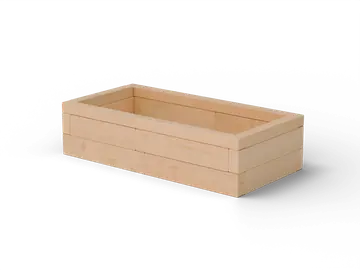
The GridGarden Brick Premium modular system uses thick European larch planks (60mm) that naturally regulate the moisture microclimate inside the bed — a practical advantage in the variable Central European summers where temperatures can swing 15°C in a single week. If you are choosing bed dimensions and materials, the 3D raised bed configurator shows real-time cost and material comparisons for every size.
Watering Tips for When You Go on Holiday
The two-week summer holiday is the most dangerous period for raised beds. Without watering, most vegetable beds show serious stress within 3-4 days in July or August. These solutions work well in combination.
Drip irrigation with timer: The most reliable solution. Set the timer before you leave, run a test day, and have a neighbor check once halfway through your trip. A properly configured system loses less than 5% of plants to drought compared to unwatered beds.
Ollas for passive irrigation: Fill all ollas to maximum before departure. A standard 2-liter olla in average summer conditions (25°C, partial sun) will maintain adequate soil moisture for 3-5 days. For a 7-10 day trip, combine with a drip timer for security.
Water storage crystals (hydrogel): Mixed into the soil at planting time, polyacrylamide crystals absorb up to 400x their weight in water and release it slowly as the soil dries. They can extend intervals between watering by 30-50% and are particularly useful for container-style raised beds. Cost: €5-15 for a full-season supply.
Deep watering before departure: Water thoroughly 24 hours before leaving — enough to fully saturate the bed to depth, not just the surface. Then apply a thick mulch layer (8-10cm) to seal in moisture. This alone buys 2-4 extra days.
Shade cloth: A temporary 30-50% shade cloth over the bed during a heat wave or holiday week can reduce water demand by 25-35%. Lightweight agricultural fleece on a simple frame works well.
Community/neighbor swap: The lowest-tech and highest-reliability option. A neighbor who waters every other morning in exchange for some of your harvest is more reliable than any timer. Leave clear, simple instructions: "One full watering can (10 liters) each morning if the soil feels dry 3cm down."
See also our guide on preparing raised beds for spring, which covers seasonal transitions including irrigation setup and shutdown.
Key Takeaways
- Raised beds dry out 40-60% faster than in-ground plots due to elevation, drainage, and solar warming of side panels — adjust expectations and watering frequency accordingly.
- The finger test (2-3cm deep) beats any schedule — check daily in summer before reaching for the hose; soil should feel damp, never bone dry or waterlogged.
- Drip irrigation with a basic timer is the best upgrade for any bed over 1m² — €40-80 setup cost, 70-90% water savings, zero daily time investment after initial configuration.
- Mulching reduces watering frequency by 30-40% with zero ongoing effort — 5-8cm of straw or bark mulch is the single most cost-effective moisture management action.
- Rainwater is better for plants than tap water in hard-water regions — a simple 210-liter barrel covers 2-3 weeks of peak-summer watering for a standard bed and costs under €60 to set up.
Sources & Further Reading
- Watering technique and frequency: Royal Horticultural Society — Watering.
- Efficient irrigation and water saving: US EPA WaterSense — Watering Tips.
- Drip irrigation design and maintenance: Penn State Extension — Drip Irrigation for Vegetable Production.
- Soil health and water retention: Michigan State University Extension — Improving Soil Health for Water Retention.
- Irrigation standards and best practice: Irrigation Association.
Plan Your Raised Bed Before You Plant
Getting the watering system right starts with choosing the correct bed size and material. Too small a bed dries out faster; the right depth and width make a measurable difference in moisture retention and root health. Use the 3D raised bed configurator to visualize your garden layout, compare larch versus softwood options, and get a precise materials list before you order. It takes 3 minutes and saves significant rework later. The GridGarden Brick Premium system ships flat-pack across Central Europe with screw-free assembly.