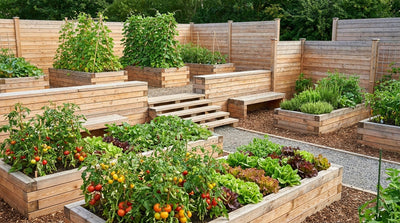
Succession Planting in Raised Beds: Maximizing Harvests All Season Long
Share
For many gardeners across Central Europe, the dream is a steady supply of fresh, homegrown vegetables, not just a single overwhelming harvest. This is where succession planting becomes an invaluable technique, especially when utilizing the efficiency and control offered by raised garden beds. By strategically planning your plantings, you can transform your garden into a continuous producer, ensuring your kitchen always has something fresh from the soil.
What is Succession Planting and Why is it Essential for Raised Beds?
Succession planting is a method of planting crops so they ripen in small batches over several weeks, rather than all at once, to maximize harvests and prevent periods of feast or famine in your garden. This technique is essential for raised beds because it allows you to get the most out of your defined growing space, ensuring every square centimetre is productive throughout the entire growing season. As the Home Garden Education Office aptly puts it,
"If looking to continuously supply the kitchen with a variety of interesting and healthy fresh vegetables, then succession planting is a technique to try."Many gardeners, as Beth Wilson of the Pulaski County Cooperative Extension Service notes,
— Home Garden Education Office, Succession Planting | Home Garden Education Office | College of Agriculture, Health and Natural Resources | University of Connecticut
"make the mistake of relying on one planting of a vegetable to be sufficient for the entire growing season."This can lead to a glut of produce at one time, followed by nothing. For example, for vegetables like lettuce and radishes, sowing seeds weekly can provide a consistent supply for salads during spring, rather than a single large harvest that quickly bolts or goes to seed. This consistent production is particularly beneficial in raised beds, where gardeners often aim for intensive cultivation and high yields from a compact area. It helps manage resources like soil nutrients more effectively and reduces the likelihood of pests and diseases becoming established in a single, large crop. To learn more about setting up your raised bed for optimal growth, consider reading our Complete Guide to Raised Garden Beds in Europe.
— Beth Wilson, Agent for Horticulture, Pulaski County Cooperative Extension Service, Succession Planting | Franklin County Extension Office
What are the Different Types of Succession Planting?
There are multiple effective ways to practice succession planting, each tailored to different crops and gardening goals. According to Gardening Solutions, these methods include using multiple planting dates, planting multiple varieties, or taking advantage of seasonal changes. Understanding these approaches allows you to choose the best strategy for your specific raised bed setup and desired harvest.
-
Staggered Planting (Multiple Planting Dates): This is perhaps the most common and straightforward method. Instead of planting all your seeds at once, you sow small batches of the same crop every 1-3 weeks. This ensures that crops mature at different times, providing a continuous harvest. For instance, you might plant a small row of radishes every two weeks from early spring until late summer. The Nebraska Extension in Lancaster County highlights this simplicity:
"By simply planting a little seed every 7 to 10 days you can ensure a continuous harvest."
This strategy works exceptionally well for fast-growing crops like lettuce, spinach, radishes, and bush beans.
— Nebraska Extension in Lancaster County, Intensive Gardening Techniques -
Planting Multiple Varieties (Different Maturity Dates): Another approach involves planting different varieties of the same vegetable that have varying "days to maturity." For example, you could plant an early-maturing tomato variety alongside a mid-season and a late-season one. While they are all planted at the same time, their harvest windows will naturally stagger. This method is excellent for crops that take longer to mature but have a concentrated harvest period, such as potatoes, corn, or certain squash varieties. It requires a bit of research into specific cultivar characteristics but can simplify the planting process.
-
Sequential Planting (Following One Crop with Another): This method involves planting a new crop in the space where an earlier crop has just been harvested. As soon as one crop is finished, the bed is prepared for the next. This is particularly effective in raised beds where soil can be quickly replenished. For example, after harvesting an early spring crop of spinach, you might plant bush beans or carrots in the same spot. In late summer, after harvesting beans, you could sow a fall crop of kale or winter lettuce. This maximizes the use of your raised bed throughout the entire growing season, from early spring through late autumn, especially in Central European climates where growing seasons are well-defined.
-
Interplanting (Companion Planting with Succession): While not strictly a succession planting method on its own, interplanting can be combined with succession strategies. This involves planting fast-growing crops between slower-growing ones. For instance, you could sow radishes between rows of cabbage. The radishes will be harvested long before the cabbage needs the full space, allowing you to utilize the bed more efficiently. Once the radishes are pulled, the slower-growing crop has ample room to expand.
By combining these methods, you can create a dynamic and highly productive raised bed garden, ensuring a steady stream of fresh produce. For more ideas on what to grow, explore our article on What to Plant in Raised Beds.
How Do I Plan My Succession Planting Schedule?
Effective planning is the cornerstone of successful succession planting, ensuring you avoid gaps in your harvest and make the most of your raised beds. Start by understanding your local climate, specifically your average last spring frost and first autumn frost dates, which are crucial for Central European gardeners. These dates define your primary growing window.
Here’s a step-by-step guide to planning:
-
Assess Your Space: Begin by mapping out your GridGarden raised beds. Consider their dimensions and how much space each crop typically requires. GridGarden's modular system, like our Brick Premium beds, allows for flexible configurations (rectangular, L-shape, U-shape, or custom designs), making it easier to designate specific zones for different succession cycles. Our GridGarden Studio 3D configurator can be an invaluable tool here, helping you visualize your layout and plan for expansion or additional beds.
-
Choose Your Crops: Select vegetables that are well-suited for succession planting. Fast-growing crops like lettuce, radishes, spinach, and bush beans are excellent candidates for staggered plantings. For sequential planting, consider crops with different growing seasons, such as spring peas followed by summer carrots, or early potatoes followed by fall kale. Consult seed packets for "days to maturity" to estimate harvest times.
-
Create a Planting Calendar: This is your most important tool. For staggered plantings, decide on a sowing interval (e.g., every 2-3 weeks). For sequential plantings, note when early crops are expected to finish and when the next crop can be sown. Factor in the time needed for soil replenishment between crops. Remember to account for the specific needs of each crop, including light requirements and temperature preferences. A simple spreadsheet or a gardening journal can help you track planting dates, expected harvest dates, and actual yields.
-
Consider Crop Rotation: Integrate succession planting with a basic crop rotation strategy. This is particularly important for preventing nutrient depletion and the build-up of pests and diseases. For instance, don't plant tomatoes (a heavy feeder) in the same spot year after year. Raised beds make crop rotation simpler; you can physically separate plant families even in close proximity. This helps maintain soil health and fertility, which is crucial for continuous production. For more on soil, see our guide on the Best Soil Mix for Raised Beds.
-
Be Flexible: Gardening is rarely perfectly predictable. Weather patterns in Central Europe can be variable, so be prepared to adjust your schedule. If a crop bolts early due to a heatwave, be ready to replace it. If spring is unusually cold, delay some early sowings. Observation is key.
Utilizing tools like the GridGarden Studio or our AI Garden Designer can help you visualize and plan your raised beds, making it easier to implement complex succession strategies. For those just starting, our article How to Start a Raised Bed Garden offers foundational advice.
Which Crops are Best Suited for Succession Planting?
Not all vegetables are ideal for succession planting. The best candidates are those with a relatively short "days to maturity," those that produce continuously over a long period, or those that can be harvested as "cut-and-come-again" crops. Here’s a breakdown of excellent choices for your raised beds:
-
Leafy Greens: Lettuce (loose-leaf varieties especially), spinach, arugula, mizuna, and mustard greens are perfect. They grow quickly and many can be harvested multiple times. Sow small batches every 2-3 weeks from early spring until temperatures become too hot in summer, then resume in late summer for a fall harvest.
-
Root Vegetables: Radishes are the quintessential succession crop, maturing in as little as 3-4 weeks. Carrots and beets also do well with staggered plantings every 3-4 weeks, especially for smaller, tender harvests. Consider planting different varieties with slightly different maturity times for added staggering.
-
Bush Beans: Unlike pole beans that produce over a long season, bush beans have a more concentrated harvest. Planting small rows every 2-3 weeks ensures a steady supply of fresh beans throughout summer. Once a planting is finished, you can pull the plants and sow a new batch or a different crop.
-
Herbs: Many herbs like cilantro and dill tend to bolt quickly in warm weather. Succession planting them every few weeks ensures a continuous supply of fresh leaves. Basil can also benefit from multiple plantings to ensure a vibrant supply for pesto and other dishes.
-
Broccoli & Cabbage (Early/Late Varieties): While these are slower growers, you can succession plant them by choosing early-maturing varieties for spring and then later-maturing varieties for a fall harvest. This utilizes seasonal changes effectively.
-
Peas: Both shelling and snap peas can be planted in succession. Sow an early batch in spring, and then a second batch a few weeks later. In some cooler Central European regions, a late summer planting can yield a fall harvest.
| Crop | Succession Method | Typical Sowing Interval | Notes |
|---|---|---|---|
| Lettuce (Loose-leaf) | Staggered Planting, Cut-and-Come-Again | Every 2-3 weeks | Harvest outer leaves for continuous supply. Resumes growth well in cooler temps. |
| Radishes | Staggered Planting | Every 1-2 weeks | Very fast turnover (3-4 weeks). Ideal for small, frequent harvests. |
| Spinach | Staggered Planting, Cut-and-Come-Again | Every 2-3 weeks | Prefers cool weather; plant in spring and fall. |
| Bush Beans | Staggered Planting, Sequential Planting | Every 2-3 weeks | Harvest concentrated over a few weeks. Plant new batch after old one finishes. |
| Carrots | Staggered Planting | Every 3-4 weeks | Requires consistent moisture. Harvest small, tender roots. |
| Cilantro/Dill | Staggered Planting | Every 2-3 weeks | Prone to bolting in heat; frequent re-sowing ensures fresh supply. |
How Can Raised Beds Optimize Succession Planting and Crop Rotation?
Raised garden beds are inherently designed for intensive gardening techniques like succession planting and crop rotation, providing numerous advantages over traditional in-ground gardens. The contained nature of a raised bed offers precise control over soil conditions, which is crucial for maximizing yields. Our Brick Premium raised beds, constructed from solid 60 mm European red larch (Larix decidua) planks, offer not just durability—expect 15-25 years in an ordinary garden; with good drainage and no standing water, 25+ years—but also a robust structure for managing your growing space effectively.
Here’s how raised beds optimize these practices:
-
Defined Growing Zones: The clear boundaries of raised beds make it easy to implement staggered planting. You can dedicate specific sections or even entire beds to a succession cycle, ensuring that as one crop finishes, another is ready or being prepared. This clear delineation simplifies planning and management, allowing you to mentally (and physically) divide your garden into productive units.
-
Superior Soil Management: Raised beds allow you to create and maintain an ideal soil mix specifically tailored for vegetables, often richer and better draining than native garden soil. This healthy, fertile soil supports continuous cropping without rapidly depleting nutrients. After harvesting a crop, it's straightforward to amend the soil with compost or balanced organic fertilisers, preparing it quickly for the next planting. This rapid turnaround is key to effective sequential succession planting.
-
Simplified Crop Rotation: While succession planting focuses on continuous harvesting within a single season, crop rotation is about long-term soil health and pest/disease management over multiple seasons. Raised beds naturally simplify this process. Building multiple raised beds can simplify the process of crop rotation, allowing for a physical barrier between garden areas even when they are close together. For instance, establishing four raised beds enables gardeners to rotate plant families so that the same botanical family is planted in a specific bed only once every four years. This strategy, as highlighted by Yard and Garden, significantly reduces the risk of soil-borne diseases and pest infestations specific to certain plant families. GridGarden's modular system makes it easy to add or reconfigure beds over time, supporting a robust rotation plan as your gardening needs evolve.
-
Better Drainage and Warmer Soil: Raised beds typically offer improved drainage, which is vital for many vegetables and prevents waterlogging. They also warm up faster in spring, extending your growing season both earlier and later, which is a significant advantage for succession planting in Central European climates. This allows for earlier spring sowings and later autumn harvests.
-
Accessibility and Intensive Planting: The elevated nature of raised beds makes gardening more accessible and encourages intensive planting. You can plant crops closer together than in traditional rows, maximizing every bit of space. This density, combined with succession planting, leads to much higher yields per square metre, making your GridGarden setup incredibly productive.
By leveraging the structural benefits of raised beds, you can create a highly efficient and productive garden that consistently delivers fresh produce, making the most of your investment in quality gardening infrastructure.
What are Common Challenges and How Can I Overcome Them?
While succession planting offers immense rewards, it also comes with its own set of challenges that can be managed with thoughtful planning and proactive measures.
-
Nutrient Depletion: Continuously growing crops in the same space can deplete soil nutrients faster than in a less intensive garden.
Solution: Regular soil replenishment is crucial. After each harvest, amend the bed with a layer of good quality compost. Consider using organic slow-release fertilisers or liquid feeds for heavy feeders. Incorporating cover crops during off-seasons or in beds temporarily out of production can also help restore soil health. Testing your soil every few years can provide valuable insights into specific nutrient deficiencies. -
Pest and Disease Build-up: Continuous presence of host plants can lead to a quicker build-up of pests and diseases specific to those crops.
Solution: Implement strict crop rotation, especially for plant families prone to specific issues. Even within a single raised bed, you can rotate where different plant families are grown each season. Practice good garden hygiene by removing spent plants promptly. Utilize companion planting to deter pests, and encourage beneficial insects. Regular inspection of your plants allows for early detection and intervention. -
Overwhelm and "Too Many Veggies": Paradoxically, successful succession planting can sometimes lead to an abundance of produce at certain times, especially if not perfectly staggered. As Gardening Solutions notes,
"“Too many fresh veggies” is a good problem to have, but it’s still a problem."
— Gardening Solutions, Succession Planting in Your Vegetable Garden – Gardening Solutions
Solution: Refine your planting schedule based on your household's actual consumption. Start with smaller batches and adjust as you learn. Share excess produce with neighbours, friends, or local food banks. Learn preservation techniques like freezing, canning, or dehydrating to enjoy your harvest year-round. -
Weather Variability: Unpredictable weather, common in Central Europe, can throw off even the best-laid plans. Early heatwaves can cause cool-season crops to bolt, while late frosts can damage tender seedlings.
Solution: Be flexible and adaptable. Have backup seeds ready for replanting. Use season extenders like row covers, cloches, or mini-hoop tunnels over your raised beds to protect early and late crops from extreme temperatures. Choose varieties known for heat or cold tolerance. Monitor local weather forecasts closely. -
Weed Pressure: Exposed soil between newly planted successions can invite weeds.
Solution: Mulch is your best friend. Apply a layer of organic mulch (straw, shredded leaves, wood chips) around your plants to suppress weeds, conserve moisture, and regulate soil temperature. Plant intensively to shade out weeds, and remove any weeds that emerge promptly before they can establish themselves or go to seed.
By anticipating these challenges and having strategies in place, you can ensure your succession planting efforts in your GridGarden raised beds lead to a consistently productive and enjoyable gardening experience.
What Tools and Resources Will Help Me Succeed?
Succession planting, while requiring a bit more planning, doesn't necessarily demand a vast array of specialized tools. However, certain resources can significantly streamline your efforts and boost your success in your GridGarden raised beds.
-
Basic Gardening Tools: You'll need essentials like a hand trowel, a small rake or cultivator for preparing planting areas, and a watering can or hose. A good quality spade or digging fork is useful for incorporating compost and aerating the soil between plantings. Pruning shears are handy for "cut-and-come-again" harvests.
-
Seed Starting Supplies: For many succession crops, especially those planted early or late in the season, starting seeds indoors gives you a head start. This includes seed trays or pots, a quality seed-starting mix, and optionally, grow lights or a heated propagation mat. This allows you to have seedlings ready to transplant as soon as a bed becomes available.
-
Gardening Journal or Planner: This is arguably the most important tool for succession planting. A dedicated notebook, calendar, or digital spreadsheet to track planting dates, varieties, expected harvest times, actual yields, and any observations (e.g., pest issues, weather impact) is invaluable. This record-keeping helps you refine your strategy year after year and learn what works best in your specific raised bed environment and Central European climate.
-
GridGarden Studio and AI Garden Designer: Our proprietary tools are designed to simplify your raised bed planning. The GridGarden Studio 3D configurator allows you to design your raised beds precisely, including custom shapes (L-shape, U-shape, or bespoke designs). This helps you visualize your planting areas and allocate space for different succession cycles. The AI Garden Designer takes this a step further, offering photo-to-render visualizations of your garden, helping you plan where new beds might fit or how existing ones can be optimized for continuous cropping. These tools, available in 10 languages, empower you to plan with precision and confidence.
-
Season Extenders: To truly maximize your succession planting in Central European conditions, consider investing in simple season extenders. Row covers, cloches, or mini-hoop tunnels can protect early spring plantings from late frosts and shield late-season crops from early autumn chills, effectively lengthening your growing window for continuous harvests.
-
Reliable Seed Sources: Choose reputable seed suppliers known for quality and variety, especially for specific maturity dates. Consider heirloom varieties for their unique flavours or open-pollinated seeds for saving your own, but always ensure they are suitable for your local climate.
By combining these practical tools with the robust foundation of GridGarden's modular raised beds, you'll be well-equipped to enjoy the continuous bounty that succession planting offers throughout the entire growing season.
Key Takeaways
- Succession planting maximizes raised bed productivity by ensuring continuous harvests, preventing gluts and empty spaces.
- Multiple methods exist: staggered planting (same crop, different times), multiple varieties (different maturity dates), and sequential planting (new crop after old).
- Careful planning, including a planting calendar and understanding your local climate, is crucial for success.
- Raised beds simplify succession planting and crop rotation through defined spaces, superior soil control, and better drainage.
- Overcome challenges like nutrient depletion and pests with regular soil amendments, crop rotation, and season extenders.
- Utilize tools like the GridGarden Studio configurator and a gardening journal for effective planning and tracking.
Frequently Asked Questions
Can I succession plant in a small raised bed?
Yes, absolutely! Succession planting is particularly beneficial for small raised beds because it maximizes the output from limited space. By choosing compact, fast-growing crops like radishes, lettuce, and spinach, and staggering your plantings every 1-3 weeks, you can achieve a surprisingly continuous harvest even in a modest GridGarden bed. The key is intensive planting and quick turnover.
How often should I amend my soil when succession planting?
For intensive succession planting, it's advisable to amend your soil lightly after each major crop harvest. This typically means incorporating a 2-5 cm layer of high-quality compost into the top 10-15 cm of soil. For very heavy feeders or if you notice signs of nutrient deficiency, you might also use a balanced organic granular or liquid fertiliser between plantings. Regular soil testing every 2-3 years can also guide your amendment strategy.
What happens if I miss a planting date in my succession schedule?
Don't worry if you miss a planting date; gardening is flexible! While it might create a small gap in your harvest for that specific crop, you can simply resume your schedule with the next planned sowing. Adjust your expectations for that particular crop, and consider planting a slightly larger batch next time to compensate. The goal is continuous harvest, not perfect adherence to a rigid schedule.
Can I succession plant warm-season crops like tomatoes or peppers?
While traditional succession planting (staggered sowing every few weeks) is less practical for long-season, single-harvest crops like tomatoes or peppers, you can still apply succession principles. For example, plant an early-maturing variety alongside a mid-season and a late-season variety to extend your overall harvest window (planting multiple varieties). In regions with long growing seasons, you might also try planting a second batch of peppers or bush tomatoes from starts in mid-summer for a late-season harvest, provided you have sufficient time before the first frost.
Is it possible to succession plant in winter in Central Europe?
Direct succession planting of most vegetables in the depths of a Central European winter is challenging due to low light levels and freezing temperatures. However, you can extend your season significantly into late autumn and start earlier in spring using cold-hardy crops (like winter lettuce, kale, spinach, or broad beans) combined with season extenders like cold frames, cloches, or mini-hoop tunnels over your GridGarden raised beds. Some gardeners also use unheated greenhouses or poly-tunnels for limited winter harvests of very cold-tolerant greens.
Sources & Further Reading
Last verified: 2026-08-03.
- Succession Planting | Franklin County Extension Office: Succession Planting | Franklin County Extension Office, "Succession Planting | Franklin County Extension Office"
- Succession Planting in Your Vegetable Garden – Gardening Solutions: Succession Planting in Your Vegetable Garden – Gardening Solutions, "Succession Planting in Your Vegetable Garden – Gardening Solutions"
- Crop Rotation in the Vegetable Garden | Yard and Garden: Crop Rotation in the Vegetable Garden | Yard and Garden, "Crop Rotation in the Vegetable Garden | Yard and Garden"
- Succession Planting | Home Garden Education Office | College of Agriculture, Health and Natural Resources | University of Connecticut: Home Garden Education Office, "Succession Planting | Home Garden Education Office | College of Agriculture, Health and Natural Resources | University of Connecticut"
- Intensive Gardening Techniques: Nebraska Extension in Lancaster County, "Intensive Gardening Techniques"
Ready to transform your garden into a continuous harvest machine? Explore the possibilities with GridGarden's modular raised beds. Design your perfect setup using the GridGarden Studio 3D configurator today and start planning your most productive gardening season yet!
Related Articles
Raised Bed Cost Calculator: Plan Your Dream Garden on a Budget
13. 08. 2026
Maximize Your Summer Harvest: Tips for Raised Bed Gardens in Central Europe
23. 06. 2026
Extending the Season: Growing Late Summer Crops in Raised Beds
17. 06. 2026