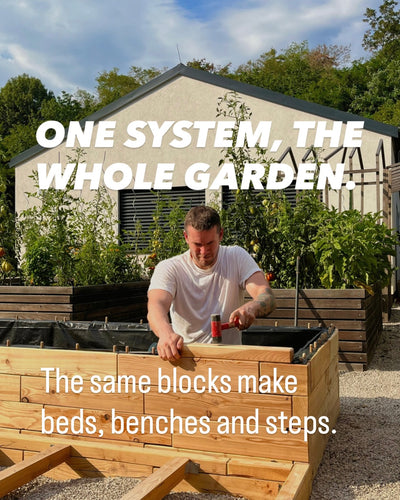
Raised Bed Buying Guide — How to Choose the Right Bed (2026)
Share
Which Raised Bed Is Right for You?
The right raised bed depends on your situation — not just your budget. A beginner with a small patio needs something very different from a family planning a full vegetable garden. Here are our recommendations by scenario:
| Your Situation | Best Choice | Budget (200×100 cm) |
|---|---|---|
| Beginner on a budget | Pressure-treated spruce, 28 mm | 80–160 EUR |
| Long-term gardener | European larch, 40–60 mm | 200–500 EUR |
| Low maintenance priority | Powder-coated steel (2 mm) | 200–500 EUR |
| Balcony or small patio | Compact wood or modular system | 80–200 EUR |
| Large garden / multiple beds | Modular system (expandable) | Varies by layout |
| Slopes or L/U-shapes | Modular planks with connectors | Varies by layout |
| Premium design statement | Corten steel or Biohort aluminium | 400–860 EUR |
Not sure where to start? Our complete guide to raised garden beds covers everything from benefits to assembly. For a quick visual comparison, keep reading.
What Materials Are Available for Raised Beds?
Wood, metal and plastic are the three main options — each with clear trade-offs between price, lifespan and maintenance. Here is a side-by-side comparison based on current European market data:
| Material | Price Range | Lifespan | Maintenance | Look & Feel |
|---|---|---|---|---|
| Spruce / Pine (treated) | 80–160 EUR | 5–8 years | Annual oiling/staining | Natural, classic |
| European Larch | 190–500 EUR | 15–25 years | Optional oiling | Warm, premium |
| Galvanized Steel | 100–200 EUR | 15–25 years | None | Industrial, modern |
| Corten Steel | 400–1,000+ EUR | 25–30+ years | None | Rust patina, designer |
| Basic Plastic | 35–250 EUR | 5–10 years | None | Modular, lightweight |
| WPC Composite | 160–420 EUR | 15–20 years | None | Wood-look, uniform |
| Stone / Concrete | 500–3,000 EUR | 30–50+ years | None | Permanent, heavy |
For a deep-dive into material pros, cons and real-world durability data, see our wood vs metal vs plastic raised beds comparison. If you already know you want wood, our guide to the best wood species compares larch, spruce, cedar, pine and oak in detail.
How Much Does a Raised Bed Really Cost?
The purchase price is only part of the story. A cheap bed that needs replacing every 5 years costs more than a quality bed that lasts 15. Here is a realistic 10-year cost comparison for a standard 200×100×72 cm bed:
| Material | Purchase | 10-Year Maintenance | Replacements | 10-Year Total |
|---|---|---|---|---|
| Spruce (KDI) | 130 EUR | ~300 EUR | 130 EUR (1×) | ~560 EUR |
| European Larch (28 mm)* | 200 EUR | ~250 EUR | 0 | ~450 EUR |
| Powder-coated Steel (2 mm) | 230 EUR | 0 | 0 | ~230 EUR |
| Plastic (JUWEL-type) | 210 EUR | 0 | 210 EUR (1×) | ~420 EUR |
| Corten Steel | 500 EUR | 0 | 0 | ~500 EUR |
*Based on standard 28 mm retail kits. Thicker larch planks (40–60 mm) with a protective liner can last 20–25+ years, significantly improving the cost per year of use.
Hidden Costs Most Buyers Forget
The bed frame is typically only half the total investment. Budget for these additional costs before you buy:
- Filling soil and compost: A 200×100×80 cm bed needs approximately 1,300–1,600 litres of layered fill. Expect 150–300 EUR for basic bulk topsoil/compost, or 350–500 EUR for a quality three-layer mix (drainage, compost, topsoil) delivered. See our soil mix guide for a cost-effective layering strategy.
- Protective liner (Noppenfolie): 15–30 EUR for wood beds. This dimpled membrane creates an air gap that prevents direct soil-to-wood contact, extending the bed's life by several years. Essential for any wood bed.
- Rodent mesh: 10–25 EUR. Galvanized wire mesh at the bottom keeps voles and moles out of your raised bed.
- Soil refresh: Every 2–3 years, the top 20 cm settles and needs topping up — approximately 30–60 EUR per refill.
What Size Should Your Raised Bed Be?
The right size depends on your body height, available space and what you want to grow. These are the expert-recommended dimensions used across Central Europe:
| Dimension | Recommendation | Why |
|---|---|---|
| Width | Max 120 cm (100 cm ideal) | Average arm reach is ~60 cm — you need to reach the centre from both sides (UGA Extension) |
| Width (wall-side) | Max 60–80 cm | Access from one side only — halve the reach distance |
| Height (standard) | 60–80 cm | Good soil depth, comfortable for most adults |
| Height (ergonomic) | 80–90 cm | Back-friendly — match to your elbow height minus 10 cm |
| Height (wheelchair) | 70–80 cm, open underneath | Min 70 cm clearance for roll-under access |
| Length | 180–200 cm (standard) | Longer beds need mid-wall bracing to prevent bowing |
The most common sizing mistake: Choosing a bed that is too wide. A 150 cm wide bed forces you to step into the soil to reach the centre, compacting it and defeating the main advantage of raised bed gardening. As University of Minnesota Extension puts it, “You should be able to comfortably reach the center of the bed to avoid needing to walk into the bed for garden maintenance, which can cause compaction.” Stick to 120 cm maximum — your back will thank you.
Height and root depth: If you plan to grow root vegetables like carrots or parsnips, ensure a minimum soil depth of 30 cm — ideally 60 cm or more (UGA Extension). Shallow beds under 20 cm are only suitable for salad greens and herbs. Taller beds also make access harder for ground-level pests like rabbits and slugs, though the effect varies by species and site.
What Makes a Quality Raised Bed? 7-Point Checklist
Not all raised beds are built to the same standard. Before you buy, check these seven quality indicators that separate beds lasting 3 years from those lasting 15:
- Wood thickness matters most. Most retail kits in DACH commonly use 28 mm planks — a decent baseline. Beds with 18–20 mm boards warp and bow outward within 1–2 freeze-thaw cycles. For maximum durability, look for 60 mm planks — they resist warping, retain heat better and last significantly longer.
- Connection system. Screw-based systems are rigid and proven. Plug-and-stack systems (Stecksystem) offer tool-free assembly and easier reconfiguration. Avoid beds where planks are only held by thin corner brackets — these are the first point of failure.
- Corner reinforcement. Budget kits often rely on screws alone at corners, which loosen over time as soil pressure builds. Quality beds use aluminium profiles, steel L-brackets or interlocking joints at every corner.
- Protective liner included? A dimpled membrane (Noppenfolie) between soil and wood extends the bed's lifespan significantly. Some kits include it, many do not — factor in 15–30 EUR if you need to buy one separately.
- Wood species and treatment. European larch is naturally rot-resistant and lasts 15–25 years depending on plank thickness — thicker boards (40–60 mm) last significantly longer than thin 28 mm planks. Spruce and pine need pressure treatment (KDI) and still last only 5–8 years. Avoid untreated softwood — it may rot within 2–3 seasons. For food safety details, see our guide to raised bed wood types.
- Expandability. Can you add a second bed and connect it later? Traditional fixed-frame beds cannot be reconfigured. Modular systems let you expand, connect beds in L or U shapes, and adapt your garden over time.
- What is NOT included. Check whether soil, liner, rodent mesh, screws and assembly hardware are included. Many "affordable" kits exclude essential accessories, making the true cost 30–50% higher than the listed price.
Buying tip: Before ordering, also check the seller's shipping policy (many beds ship free within the EU but charge for remote areas), return terms (look for at least 14-day returns) and warranty coverage. A quality manufacturer should offer a written warranty on structural integrity — if they do not, that tells you something about expected lifespan.
Why Consider a Modular Raised Bed System?
Traditional raised beds are fixed: one size, one shape, one location. If your needs change — a bigger garden, an L-shaped corner, an additional bed for herbs — you start from scratch. Modular systems solve this by using standardised planks and connectors that can be assembled into any shape.
Key advantages of modular raised beds:
- Any shape, not just rectangles. L-shapes for corner spaces, U-shapes for courtyards, or multiple connected beds — all from the same components.
- Start small, grow later. Begin with one bed this season and expand next year using the same system. No waste, no incompatibility.
- Tool-free assembly. Most modular systems use interlocking planks and connectors that snap together without tools — a typical bed takes 15–30 minutes to assemble.
- Relocatable. Moving house? Disassemble, transport and rebuild in the new garden.
- Build with premium modular planks. GridGarden’s 60 mm Brick Premium modular planks in European red larch use snap-in wooden connectors for tool-free assembly and a 25+ year service life — a single system that scales from a small herb bed to a multi-shape vegetable garden.
Want to see what your garden could look like? Use our free 3D raised bed configurator to design beds in any shape and size, choose your wood type, and see an instant price — all before ordering. Or browse our complete raised bed collection to see ready-made options with free shipping across Europe, hassle-free returns and a full warranty on every product.
What Should You Expect for Assembly and Delivery?
Most raised bed kits are delivered flat-packed and require self-assembly — no professional installation is included. Here is what to plan for:
- Assembly time: Simple screw-together kits take 30–60 minutes with basic tools. Modular plug-in systems assemble in 15–30 minutes without any tools.
- Delivery: Standard beds ship via parcel service. Larger or heavier kits (metal, thick wood) may arrive on a pallet — check if curbside or doorstep delivery is included.
- Shipping costs: Many European manufacturers offer free shipping within their home market. Cross-border shipping to other EU countries typically adds 20–50 EUR depending on weight and destination.
- Returns: EU consumer law guarantees a 14-day return period for online purchases. Check if the seller covers return shipping — some do, many do not.
Key Takeaways
- Think in total cost, not purchase price. A 130 EUR spruce bed costs approximately 560 EUR over 10 years once you add maintenance and replacement. A 230 EUR steel bed costs just 230 EUR over the same period.
- European larch is the best all-round wood — naturally rot-resistant (EN 350 durability class 3). With a protective liner and no ground contact, thicker 40–60 mm boards typically reach a 15–25 year lifespan. Available from approximately 190 EUR for a standard bed.
- Width should never exceed 120 cm (100 cm is ideal). This is the single most important dimension for comfortable gardening.
- Budget for filling soil separately — it often costs as much as the bed frame itself (150–500 EUR depending on bed size and soil source).
- Modular systems offer the best flexibility — expand, reshape and relocate your beds as your garden evolves.
What Working Gardeners Recommend
Beyond product spec sheets, university extension services have published decades of practical raised-bed guidance. Four recommendations consistently appear across primary sources:
“Plan raised beds that are 3 feet wide for children and 4 feet wide for adults.”
“You should be able to comfortably reach the center of the bed to avoid needing to walk into the bed for garden maintenance, which can cause compaction.”
“Raised beds can be designed to eliminate the need to kneel, making the garden physically easier to work and maintain.”
“Build your raised bed with a decay-resistant type of wood, such as cedar, black cherry, oak, black locust, Osage orange, or redwood.”
European red larch is not on the UMD list because it is rare in North American supply chains, but it sits in the same EN 350 durability class as oak and is the dominant rot-resistant softwood across Central Europe.
Frequently Asked Questions
How much should I spend on a raised bed?
For a durable, standard-sized bed (200×100 cm) in European larch, expect 200–320 EUR for the frame alone. Add 150–250 EUR for filling soil and 15–30 EUR for a protective liner. A realistic total budget is 350–600 EUR for one complete bed. Budget beds under 100 EUR typically use thin wood (18–20 mm) that needs replacing within 3–5 years.
Is wood or metal better for raised beds?
It depends on your priorities. Wood (especially larch) looks warmer, insulates soil better in winter and costs less upfront. Metal (galvanized or powder-coated steel) lasts longer, needs zero maintenance and wins on total cost of ownership over 10+ years. For a full comparison, read our material comparison article.
How tall should a raised bed be?
For standard gardening, 60–80 cm is ideal. If you want a back-friendly, ergonomic height, choose 80–90 cm — a good rule of thumb is your elbow height minus 10 cm. For wheelchair access, 70–80 cm with open space underneath is recommended.
What is the best wood for a raised bed?
European larch (Lärche / smrekovec) is the top choice in Central Europe — it naturally resists rot for 15–25 years without chemical treatment, making it safe for growing food. Thicker planks (40–60 mm) with a protective liner can last 25+ years. Spruce and pine are cheaper but last only 5–8 years even with pressure treatment. See our detailed wood comparison.
Can I build a raised bed in an L-shape or U-shape?
Yes — but only with modular systems that use connectors designed for angled joints. Traditional fixed-frame kits are rectangular only. Modular plank systems like Brick Premium let you build L-shapes, U-shapes, and even connected multi-bed layouts using the same components. Our 3D configurator lets you design and preview custom shapes for free.
What warranty should a raised bed have?
Look for a written structural warranty of at least 2 years — quality manufacturers offer 5–20 years depending on material. Metal beds (especially Biohort with its 20-year warranty) tend to have the longest coverage. For wood beds, the warranty should cover warping and structural failure, not natural greying. If a seller offers no warranty at all, consider it a red flag.
How much does raised bed shipping cost across Europe?
Within the manufacturer's home country, shipping is often free for orders above 100–150 EUR. Cross-border EU delivery typically costs 20–50 EUR extra depending on weight and distance. Heavier beds (metal, thick wood) may ship on pallets. Always check whether delivery is to your door or curbside only — pallet deliveries often require you to carry the packages from the street.
Sources & Further Reading
- Berle, D. & Westerfield, B. (2022). Building Raised Beds. University of Georgia Extension, Circular C 1027-4.
- University of Minnesota Extension. Raised Bed Gardens.
- Heflebower, R., Wagner, K., Gunnell, J. & Condrat, A. Raised Bed Gardening. Utah State University Extension.
- University of Maryland Extension. Safety of Materials Used for Building Raised Beds.
- Miernicki, E. A. et al. (2018). Raised bed vs. in-ground production of leafy crops. Urban Agriculture & Regional Food Systems 3(1).
- Swedish Wood (Svenskt Trä). Durability and Resistance — EN 350 Classification.
Design Your Perfect Raised Bed
Ready to find the right bed for your garden? Use our free 3D raised bed configurator to choose your shape, size and wood type — see it in 3D, get an instant price and order directly. No guesswork, no surprises. Whether you need a simple rectangle for your first herb garden or an L-shaped layout to fit a tricky corner, the configurator handles it all.
Related Articles
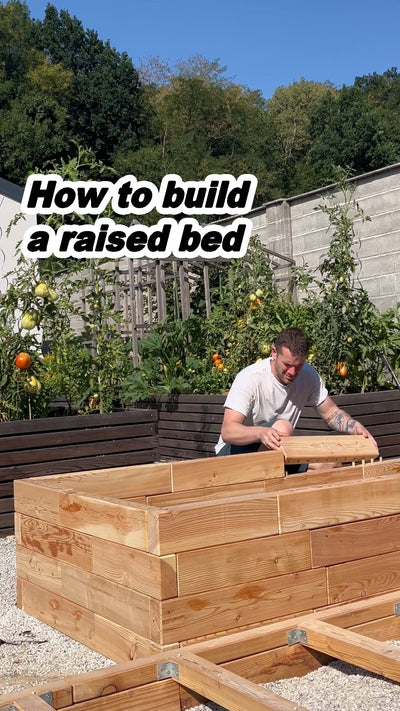
Raised Bed Cost Comparison: Larch vs. Other Materials in Central Europe
26. 08. 2026
Growing Perennials in Raised Beds: A Guide for Central Europe
25. 08. 2026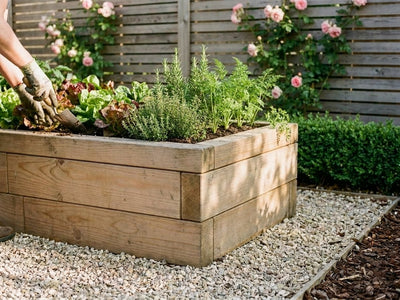
Choosing Your Raised Bed: Larch vs. Metal, Plastic & Composite (A Buyer's Guide)
24. 08. 2026